
Introduction
What if an entire island fell completely silent? No cars. No motorbikes. No music. No planes landing or taking off. No lights on after dark. Millions of people, both tourists and natives alike, choose to pause, take a breath, and simply be.
Welcome to Nyepi: Bali’s Day of Silence. There’s nowhere on earth quite like it.
Are you an individual who has always wanted to experience the true Bali – the Bali without the noise, without the commercialism, without the tourist industry? Look no further. This guide will walk you through everything you need to know about the experience of a lifetime. What is it? Just how is it celebrated? What’s so special about the days leading up to it? What’s it really like as a visitor? And just how could it be the most unforgettable day of your existence?
What Is Nyepi? What is Bali’s Day of Silence?
Ready to experience Bali?
52 luxury villas. Best rate guaranteed. Free beach club access when you book direct.
BOOK →Nyepi (pronounced nyeh-pee) is the Balinese Hindu New Year. It’s based on the Balinese calendar system known as the Saka calendar. This calendar sets the Balinese New Year between March and April. Unlike the New Year’s celebrations of the rest of the world, however, it’s not a time of celebration. Instead, it’s the opposite. It’s the day of complete silence and introspection.
The word "Nyepi" is derived from the Balinese word "sepi," which means "quiet" or "still." The entire island of Bali, an island of 4.2 million people in the province of Indonesia, observes the following four sacred prohibitions on the day of Nyepi:
• Amati Geni – No fire or light, including electricity
• Amati Karya – No working
• Amati Lelanguan – No entertainment or pleasure activities
• Amati Lelungan – No travelling or movement outside the house
Again, these are not recommendations. These are enforced through Bali's traditional security forces, the Pecalang, who patrol the streets to ensure that everyone complies. The airport shuts down. The streets are empty. Warung and restaurant businesses are closed. Bali's famous nightlife in areas like Seminyak, Canggu, and Kuta goes dark.
For 24 hours, from 6 am on Nyepi day until 6 am on the following day, Bali becomes something almost impossible to imagine: a place of genuine, spiritual silence.
The Spiritual Meaning behind the Silence
To comprehend why Bali goes silent, it's necessary to comprehend the spiritual underpinning behind Bali's Nyepi. Bali is an island that practices Balinese Hinduism, an animistic religion that believes Bali itself is a spiritual being inhabited by both good and bad spirits that have to be kept in balance.
The eve before Nyepi day sees a massive ritual ceremony aimed at driving away all evil spirits. Nyepi day itself sees Bali go dark and silent for one very important reason: to deceive any remaining demons into thinking that Bali has been abandoned. Finding no humans, no lights, no sound, and no signs of any activity, the evil spirits, or Bhuta Kala, lose interest and move on.
And yet, there is spiritual logic at play that goes beyond demon-tricking. At its heart, Nyepi is an exercise in renewal, a collective rebooting of the Balinese people, their societies, and even nature itself. In today’s world, it has become an amazing exercise in environmentalism. For one day a year, an entire island goes into suspended animation, and the night sky above Bali is filled with stars that can only be seen on that one night.
Ogoh-Ogoh: The Spectacular Parade of Demon Statues
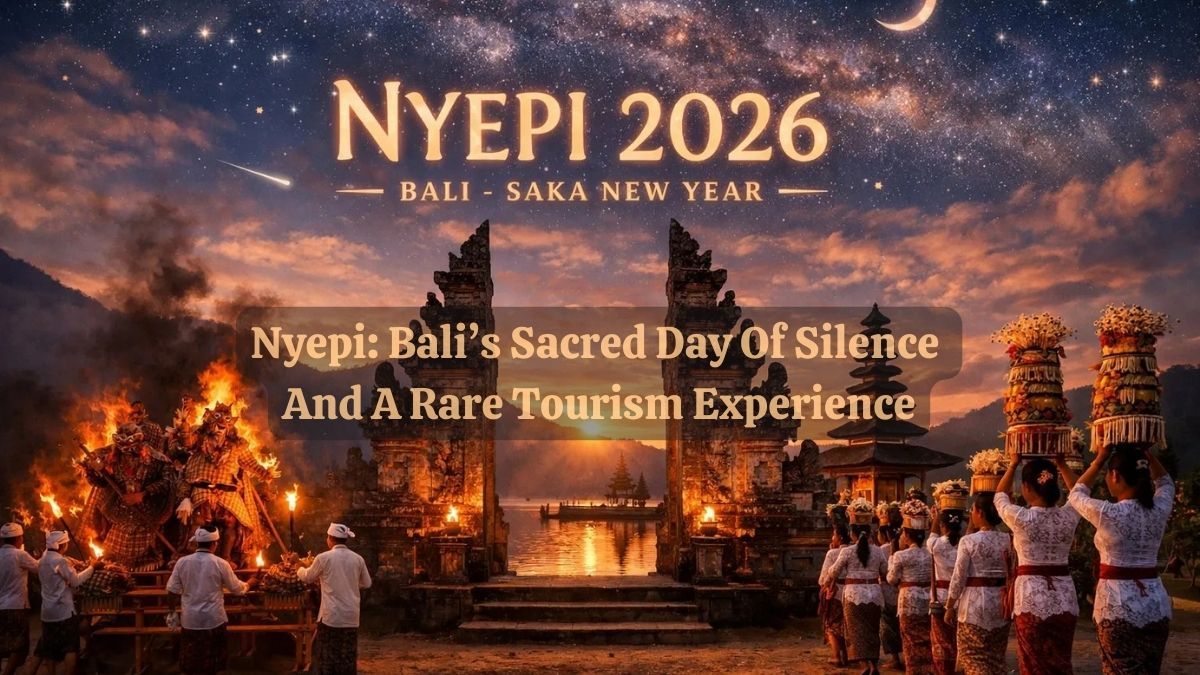
The eve of Nyepi, known as Ngrupuk, is anything but quiet. In fact, it is one of the most spectacular displays of culture and art that can be found anywhere in Asia, and most people visiting Bali are unaware of it.
In the weeks leading up to Nyepi, young men from each banjar spend their evenings crafting massive papier-mâché Ogoh-Ogoh, demon statues of Bhuta Kala, which are grotesque, wonderful, and terrifying all at once. Some of them are as much as three or four stories high. They are decorated with wild eyes, a menacing mouth, claws for hands, and are painted in vibrant reds, greens, and golds. Some of them are incredibly advanced, with moving parts that allow the arms and hands, and sometimes the eyes, to move as they are paraded through the streets.
On the eve of Nyepi, the Ogoh-Ogoh are paraded through the streets by torchlight, carried by dozens of young men balanced atop a bamboo pole. The parades are accompanied by the deafening sounds of gamelan orchestras, and people line the streets, perched atop the shoulders of the paraders. There is much smoke in the air, and the Ogoh-Ogoh are spun round and round in circles as they reach intersections, a ritualistic act intended to confuse and disorient the evil spirits that they are intended to represent.
Finally, as the Ogoh-Ogoh reach the end of the procession, they are set alight, a symbolic burning that is intended to purify them one last time before the silence of Nyepi begins.
If you are in Bali during the time of Nyepi, the Ogoh-Ogoh parade is a spectacle not to be missed. While the main Ogoh-Ogoh processions take place in the town center of the respective regions, the biggest and most spectacular one being in Puputan Square in the capital city of Denpasar, the respective village areas have their own Ogoh-Ogoh parade. The one outside your villa may be as moving as the one in the town centre.
The Days Leading Up to Nyepi: Melasti and Tawur Agung
It is a common misconception that Nyepi is a standalone event. While it is true that the day of silence is the main event, the week leading up to it is a series of interconnected events. Understanding the days leading up to Nyepi adds immense depth to the experience.
Melasti - The Purification at the Sea
Three to four days before the day of silence, the Melasti ceremony takes place. Melasti is a mass procession to the sea, or a sacred spring, river, or lake, during which the devotees carry the sacred objects (pratima and pralingga) from the respective temples to the water for a ritual purification.
If your villa is located in the coastal areas of Seminyak, Canggu, Sanur, Kuta, etc., you may wake up one morning to see hundreds, even thousands, of devotees dressed in their best traditional attire of white and yellow walking along the road carrying elaborate ceremonial palanquins decorated with umbrellas and flowers. The beach is a temple. The devotees are offering prayers and making offerings. It is a spectacle not to be missed.
Melasti is one of the most beautiful spectacles you will see in Bali. While it is a coincidence that you may not have planned your trip to witness the spectacle, it is a coincidence that will turn out to be one of the most memorable experiences of your trip to Bali.
Tawur Agung Kesanga - The Great Offering Ceremony
The day before Nyepi, Tawur Agung Kesanga is performed throughout the island. This is the major exorcism ritual – a cosmic cleansing rite to rid the world of evil spirits. Priests conduct elaborate offerings, prayers, and sacrificial rites. The mood is solemn, sacred, and communal.
This ceremony ends with the Ngrupuk procession and Ogoh-Ogoh parade on the same night – a dramatic shift from sacred ritual to street carnival only possible in Bali.
What to Expect as a Visitor on Nyepi Day
Nyepi is applicable to all on the island – including visitors. As a visitor to Bali during Nyepi, you are required to stay within your hotel or villa throughout the 24 hours. Be warned: if you are caught outside by the Pecalang, you risk causing a diplomatic scandal for your country.This is how you can expect to spend your time on Nyepi Day if you are a visitor to Bali in a managed villa or hotel:
• You are not allowed to leave your premises. Be prepared to be confined to your hotel or villa throughout the 24 hours.
• Managers of good villas will ensure you are well stocked with supplies such as food, drinking water, candles, books, and activities to keep you occupied throughout the day.
• You are required to turn off all outdoor lights after dark. Many villas draw their blackout curtains or cover outdoor lighting to ensure total darkness.
• You are allowed to keep your lights on indoors, Wi-Fi and TV on – or you can follow the Balinese lead and turn everything off.
• The silence will be unlike anything you have ever experienced. No traffic noise, no music playing from cars or shops, no aeroplane noise. Just the wind and the birds. And the occasional gamelan music from a temple in the distance.
Many travellers who dreaded being confined to their hotel for an entire day report that it was their favourite day of their vacation in Bali. There is something therapeutic about being forced to slow down. No agenda, no activities, no sightseeing. Just being.
How to Make the Most of Your Nyepi Experience
If you happen to be in Bali on the day of New Year’s Eve of the Hindu calendar, a little bit of planning will turn an inconvenience into an unforgettable experience.
Stock Up in Advance
All shops and warungs close on the day of the holiday. Make sure to stock up on food and any medicine that might be needed at least one day in advance. Most supermarkets also close on Ngrupuk night, so be sure to plan ahead and stock up on anything that might be needed the day before.
Stay in a Quality Villa or Resort
The quality of your villa or resort will make a big difference on the day of the holiday. A well-managed villa will offer its guests a special package that includes pre-cooked meals, candles and lanterns, and any information they might need about the holiday. A poorly managed villa will probably leave its guests feeling bewildered and unprepared. If the holiday occurs during your stay in Bali, ask your villa or resort in advance what they have planned for the holiday.
Embracing the Darkness
On Nyepi night, go outside in your garden after dark. Step outside carefully and quietly, and look up at the sky. With the entire island in darkness, the sky on Nyepi night in Bali is something special. You can even see the Milky Way with the naked eye. All of our guests have done this and say it is one of the most beautiful experiences of their lives.
Treat It as a Meditation Retreat
The Balinese use Nyepi for meditation, prayer, and fasting. There is something about immersing yourself in the spirit of Nyepi, whether it is by keeping a journal, avoiding social media, doing some yoga in the garden, and reading books that you have been meaning to get around to for years, that creates a kind of mental clarity that is genuinely hard to find in the world outside Bali. You might find that you are incredibly grateful for the experience of Nyepi.
Nyepi Across Bali: How Different Areas Experience the Day of Silence
While the principles of Nyepi are honoured throughout Bali, the experience of the day of silence is quite different in various areas of Bali.
Ubud
In Bali's cultural heartland, Nyepi is a particularly powerful experience. The Ogoh-Ogoh parades in Ubud are generally of a higher spiritual quality, less glittery and commercial, and the experience of silence is particularly powerful in a rural landscape of rice fields and jungle. Many yoga and wellness centres will host special events for Nyepi Day.
Seminyak and Canggu
In Bali's most cosmopolitan areas, Nyepi is a particularly surreal experience. The usually incessant noise and traffic of these areas just stops. People who are staying in luxury villas in Seminyak comment that the silence is almost disorienting, and then utterly beautiful. The Ogoh-Ogoh parades of the night before attract huge audiences of locals and visitors of all ages and nationalities.
Uluwatu
On the Bukit Peninsula, where dramatic clifftop villas offer a bird's eye view of the Indian Ocean, Nyepi can be a time when it feels as though the world has come to an end in the most peaceful of ways. There are no planes flying overhead and no boat engines rumbling in the water below. It is a time of complete and total silence – for one day. The temples perched on the cliffs are only lit with the light of the stars.
Practical Information for Travelers
When Is Nyepi ?
Nyepi occurs at a different time each year based on the Saka calendar, a lunisolar calendar used in Indonesia. It generally falls in late February or early April. Nyepi occurred on March 29 in 2025. It will occur on March 19 in 2026. It is a good idea to refer to the Balinese calendar when planning a visit.
The Airport Closes
The Ngurah Rai International Airport closes during the entire time of Nyepi. There are no arrivals or departures during those 24 hours. If you are planning a flight into or out of Bali during Nyepi time, plan on arriving at least one day prior and leaving at least one day after. Airlines announce flight changes well in advance of Nyepi.
The Ngoerah Rai Hospital and Emergency Services.
Emergency services are available during Nyepi. Hospitals are open during Nyepi time. If an emergency arises, contact the emergency service line. Your hotel or villa will be able to help.
Why Nyepi Matters: The Deeper Lesson for the World
In a world that does not stop, where notifications are endless and every moment is content, where silence is threatening rather than sacred, Nyepi is almost radical.
Scientists have studied the environmental effects of Nyepi, and they are remarkable. Air pollution is greatly reduced. Noise pollution is completely gone. The beaches are deserted by fishing boats and surfers. The sea turtles take advantage of the quiet to come ashore by the hundreds.
But aside from all that, there is something rather philosophical at work in what the Balinese are choosing to do. They are saying: a day a year, we stop. We rest. We think. We remember that we are a part of something bigger than we are—a community, a spiritual reality, an island itself.
And for those visitors who have had the privilege of experiencing Nyepi, there is a kind of quiet epiphany. They had not realised how much noise they had grown to live by until it was gone. They had not felt the texture of true quiet since they were children. They had not looked at a star-filled sky since they could not remember when.
Nyepi gives you that back for one extraordinary day.
Conclusion - Planning Your Nyepi Experience in Bali
If you are planning a trip to Bali and have any flexibility in your dates, consider timing your visit to include Nyepi. It does require a little extra planning and effort on your part: stocking up on supplies, changing your flight dates, etc. But the benefits are immeasurable.
The night before, you will stand in the street watching twenty-foot demon statues parade past by torchlight to the sound of gamelan music. And the next morning you will wake to absolute silence — and realise, perhaps for the first time in years, what peace actually feels like.
That is Nyepi. And there is nothing else like it on earth.
Looking to experience Nyepi from a private luxury villa ? At OriVista, our managed villas in Seminyak, Canggu, Ubud, and Uluwatu include full Nyepi preparation.